|
|
|
|
|
|
|
|
J.A.
KOLODZIEJ, A.P. ZIELINSKI, University
of Technology Poland
Boundary Collocation Techniques
and their Application in Engineering
WIT Press, UK, 2009
ISBN: 978-1-84564-394-2, eISBN: 978-1-84564-395-9,
336 pages
For orders, please contact the author
at the following address:
jroper@witpress.com and dhalzack@witpress.com
|
| |
|
The book represents an
important contribution in the field of mathematical
modeling applied in contemporary computational
mechanics. The contents is divided into
two parts. In the first part is a general
presentation of the boundary collocation
approach and its numerous variants. In the
second part the method is applied to many
different engineering problems, showing
its properties, accuracy and convergence.
Both evident advantages and also limitations
of the approach are clearly presented. The
observations are based mainly on investigations
carried out in the last two decades by the
authors and their co-operators.
|
|
|
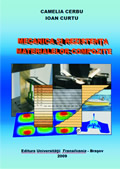
Camelia CERBU, Ioan CURTU
Mechanics and Strength of Composite
Materials (in Romanian language)
PUBLISHED IN:
Editura Universitatii "Transilvania",
Brasov
ISBN: 978 973 598 616-8, 250 pagini .
Details: cerbu@unitbv.ro
|
| |
|
The book contains 11 chapters
and it gradually taps the fundamental concepts
within the field of composite materials
mechanics. The first two chapters, acquaint
the reader with the specific terminology
of this field: classification and applications
of the composite materials; properties of
the component materials (reinforcement material,
matrix); tendencies in manufacturing of
composite materials from the recycled wastes.
Then, the concepts concerning the micromechanics
of the composite materials are introduced,
that develops calculus relations for elastic
and mechanical characteristics corresponding
to the composite material ply unidirectional
reinforced. The upfollowing section shows
some analytical calculus models. Solved
problems introduced in the final of some
chapters enhance the learning of the calculus
steps that must be covered in case of a
structure made of laminated composite material
with plies made of different materials and
/ or with different orientations of the
fibres within the plies.
|
|
|
|
|
|
|
|
|