|
The first activity performed within
the FP7-Project PRO WOOD was a Fact-Finding Analysis
concerning the present state and needs of the
wood industry sector in the Brasov-Covasna region.
Based on a questionnaire developed by ZENIT GmbH
(Germany), the interview was conducted by Transilvania
University-Faculty of Wood Industry in the Brasov
region and by ASIMCOV in the Covasna region. The
questionnaire was distributed to a total number
of 237 enterprises, out of which 102 responded.
The responders are mainly furniture producers
from Covasna region, but also timber manufacturers
and various providers for tools, machines, adhesives,
lacquers etc. from both regions.
The questionnaire included questions
concerning:
1. Infrastructure
-
IT solutions (web presence, E-mail, high speed
internet, E-commerce);
-
means of transportation;
-
technical endowment.
2. Human Resources
-
recruiting facilities;
-
recruiting difficulties, both for academic and
non-academic staff.
3. Networking Activities
-
institutions for collaboration;
-
affiliation to an association;
-
activities at international scale.
4. Business Environment
-
distribution markets;
-
service providers - existing and needed;
-
support concerning business start-ups.
5. Research and Development
-
interest concerning active involvement in R&D
project;
-
fields of cooperation with R&D institutions
-
present and desired.
6. Public Authorities
-
present role and expectations.
7. Interest in becoming a member of the Wood Cluster.
The results of the questionnaire can be summarised
as follows:
1. Infrastructure
-
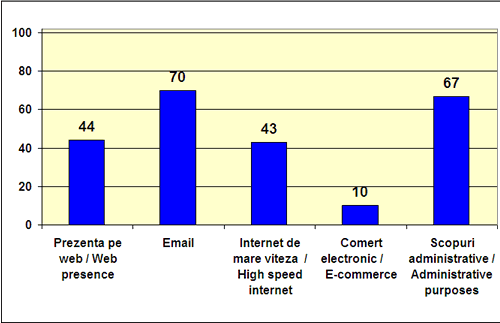
with regard to IT-solutions (Fig. 1), most of
the responders are using E-mail, whereas a web
page of the company cannot be taken for granted;
nearly 2/3 of the companies use IT solutions for
administrative purposes; E-commerce is of nearly
no interest;
- with regard to the transportation
issue, most of the respondents (over 50%) are
satisfied with the transportation system, whereas
only 1/4 of the respondents consider it insufficient;
- considering that the main means of transportation
used are trucks (93%), over 40% of the respondents
asked for more and better roads, as well as better
connections between roads;
existing technical/manufacturing equipment was
rated as sufficient by 50% of the respondents.
2. Human Resources
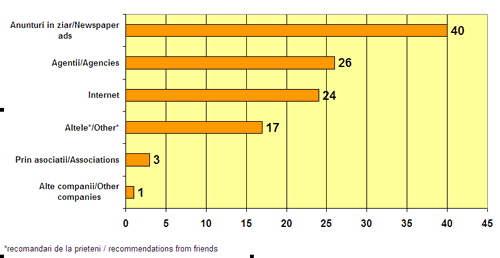
- when recruiting employees (academic as well as
non-academic) (Fig. 2), newspaper ads, the Internet
and special agencies are used; nearly no recruiting
activities take place by means of networking (e.g.
between companies);
- the respondents have more problems
recruiting non-academic staff than academicals.
Nevertheless it is not easy to find qualified
staff.
3. Networking Activities
- most respondents are collaborating with the chambers
of commerce in Brasov and Covasna;
- nearly half of the respondents are not a member
in any association;
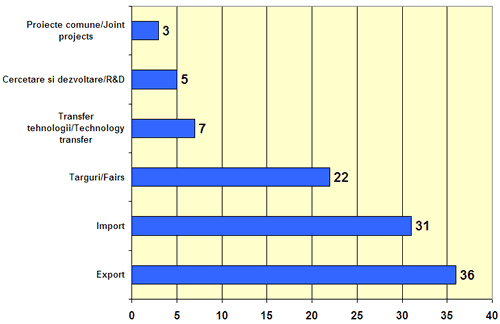
- international activities have a quite traditional
motivation: import, export and fairs (Fig. 3).
4. Business Environment
-
the respondents mainly supply the regional and
the national market;
-
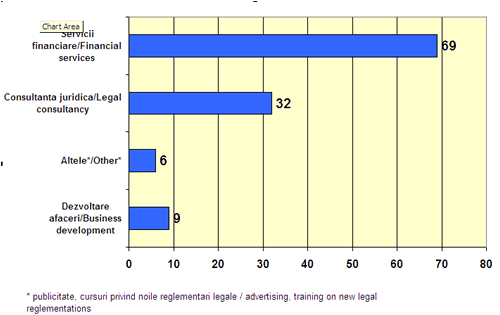
financial services and legal consultancy (Fig.
4) are the main demanded services by the respondents;
-
services that would be needed and do not exist
so far are special insurances (for transport,
clients, export etc.);
-
services that the respondents would like to make
use of are: advertising/marketing, technology
-
transfer, research & development, training
for technical consultants;
-
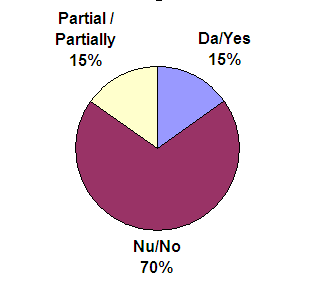
asked about the existence of any support for business
start-ups, 90% of the respondents answered no.
5. Research and Development
-
the collaboration with research institutions or
universities hardly exists; more than one third
are not interested in an R&D activity;
-
the main cooperation fields the respondents could
imagine are product development, environmentalism,
service improvement and process automation (Fig.
5);
-
the financial means to cooperate in a research
project are very low, more than 50% could not
afford a participation.
6. Public Authorities
-
these seem not to play an important role; many
of the respondents qualify them as braking factor
for business development;
-
half of the respondents would expect more support
from public bodies: legal regulations have to
be applied more strictly, specialists for market
control should be professionals, fiscal incentives
should be lowered for producing enterprises, enterprises
should be checked for their opinion when changing
their working environment (like infrastructure)
et al.
7. Interest in becoming a member of the Wood Cluster.
-
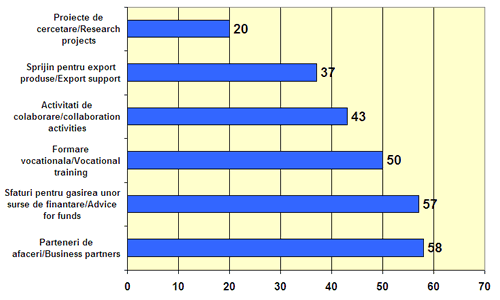
the expressed demand for activities in PRO WOOD
mainly compass funding advice, qualification and
the search for networking partners; the demand
for research projects is represented by the fewest
(Fig. 6);
- basically, an attitude of cooperation
with PRO WOOD exists and a contribution to activities
within PRO WOOD is conceivable for most responders.
According to the obtained results, the following
weaknesses could be pointed out, shaping thus
the spectrum of activities of the future cluster:
- low utilization of IT solutions;
- bad roads and connections between roads;
- poor qualification of non-academic staff;
- low membership in association;
- need for product diversification and export
of products with higher added value;
- reluctance in participating to R&D
projects;
- lack of strategic planning;
- low support of business start-ups;
- mistrust between business and administration.
The demands of the wood sector in regions Brasov
and Covasna are to be further investigated within
four peer-review workshops focussed on the four
"hottest" topics revealed by the questionnaire:
- Education (non-academic staff);
- nformation Techologies (and their utilization
for promotion purposes);
- Research and Business Cooperation;
- Sales and Marketing.
Based on the knowledge acummulated from these
two investigation procedures, the project consortium
will establish the activities to be carried out
in future so as to meet the main demands required
by the wood industry sector in the Brasov-Covasna
region.
|