|
PROWOOD
FP7Project - No 202967 - SP4 Capacities / Financed
by the European Commission
Starting with May 2008, the Faculty of Wood Industry
in Brasov is partner in a new international project,
coordinated by the German firm ZENIT. The main
aim of the project is to promote wood industry
and to strengthen the links between research and
industry in the regions of Romania (Covasna being
the region chosen as pilot for this project),
by using the expertise and good practice from
other wood clusters already created in different
countries of the European Union. Beside the economic
effects at regional level, it is also expected
that the creation of this cluster will support
the integration of the region in the EU area.
What is a 'cluster'?
Literally, a cluster is a group of the same or
similar elements gathered or occurring closely
together; a bunch. From an economic perspective
a cluster is a network of manufactures, suppliers,
research institutions (e.g. universities), service
providers (e.g. software engineers) and related
institutions (e.g. chamber of commerce). They
are all characterized by the focus on the same
type of sector and a spatial proximity.
The network cooperates along the value chain and
their members pursue similar interests.
The basic
requirements for the success of a cluster arethe
will to cooperate and to share knowledge!
The project forms a well-balanced and efficient
consortium of 8 partners from 4 countries: Germany,
France, Finland and Romania. The partners were
chosen so that all main actors are represented:
- experts in the formation of clusters - reknown
research institutes from EU countries (ZENIT and
Fraunhofer-Germany, CRITT-France and TTS-Finland)
- responsible for the know-how transfer towards
Romanian project partners;
- beneficiaries of the know-how transfer - the
productive sector specific to wood industry in
Covasna
region (represented by ASIMCOV Covasna),
the "Transilvania" University of Brasov
- as research and education institution which
will be able to take over in future the development
of other clusters in Romania, according to this
model;
- other institutions, having the role of sustaining
the implementation at local level - the Chamber
of Commerce Covasna and for disseminating the
results at national level - INNO Consult Bucharest.
The project
duration is 2 years and it includes the following
main stages:
- May-November
2008: Analysis of present state - establishing
on questionnaire basis the disponibility of technical
and human resources in wood industry in Covasna
county;
- December
2008: Establishing a strategy (activity plan)
for strengthening the cluster - through projects,
training programs etc.;
- January
2009 - May 2010: Implementation of this strategy
and creation of a web platform.
In the following, we give a short introduction
to the project coordinator - the German firm:

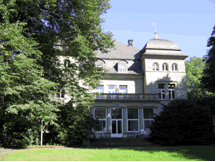
Founded
in 1984, ZENIT is the central innovation and technology
transfer agency in the state of Nordrhein-Westfalen
(NRW) in Germany. ZENIT's primary political vocation
is to support the industrial structural change
in the Land and in particular in the Ruhr valley
by supporting the use of new technologies and
innovations in SMEs in NRW. ZENIT's target groups
comprise industrial enterprises, institutions
and public administrations in Germany and other
European countries.
ZENIT has been dealing with Cluster Initiatives
(CIs) since the days CIs have become an important
part of structural policy. The staff of ZENIT
supports the regional government of Nordrhein-Westfalen
with all cluster related questions, it is supporting
clusters itself and has made several comparative
studies on cluster strategies. Furthermore ZENIT
has developed a moderation methodology to transfer
know how from good practice demand driven and
action orientated.
Furthermore ZENIT has profound knowledge of cluster
concepts through various research and consultancy
projects. ZENIT evaluated a number of clusters
in Europe and identified policy approaches for
the regional government. Regarding Central and
Eastern Europe (CEE) experience, ZENIT has gained
a profound knowledge in several projects, mainly
in Romania, Bulgaria, Poland and recently in Moldova.
The projects are principally focused on technical
assistance, technology transfer and regional development.
ZENIT is also responsible for the overall project
management that will be carried out by Mrs. Susanne
JAKOBS, Mrs. Claudia MÜHLENFELD and Mr. Michael
GUTH.
|
|
|
|
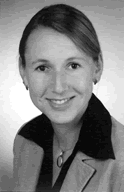
Susanne
JAKOBS
|
Claudia
MÜHLENFELD
|
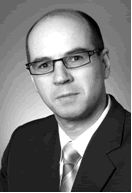
Michael
GUTH
|
Susanne
Jakobs has studied Social Science at the University
of Duisburg (Germany) and at the Université
Catholique de l'Ouest, Angers (France). After
her studies she made an internship in an agency
for Public Affairs, Research & Consulting
in Brussels. In 2003 Susanne Jakobs joined ZENIT
in order to work in projects in the field of regional
innovation and cluster policy. Since December
2003 she is member of the Commission's expert
group on regional foresight and contributed to
the TRANSVISION foresight group, focusing on regions
sharing common borders. Furthermore she effectuated
an analysis of innovative clusters at European
level and evaluated transferable approaches of
good practice cluster policy for the Ministry
of North Rhine Westphalia. In addition she has
collaborated to the evaluation of innovative and
social integrative cluster approaches in an international
comparison on behalf of an organisation of the
German Trade Union. Susanne manages an INCO project
Future-For-MD to analyse possible future possibilities
in the sector ICT and agro-food in the Republic
of Moldova.
Claudia
Mühlenfeld has a degree in Political
Sciences and is working for ZENIT since 2001.
She gathered great experience in the field of
structural innovation policy by designing and
conducting European-wide studies regarding clusters,
network or other types of regional innovation
strategies. Subsequent to these studies she implemented
workshops with regional experts to verify the
transferability of examples of good practice to
the Land of North Rhine Westphalia. Claudia also
delivers consultancy in funding (regional, national,
EU) to small and middle-sized companies. One other
service she provides for small and middle-sized
companies is the support for international co-operation
(e.g. import/export, search for sales partners,
strategy finding etc.).
Michael
Guth has a degree in political economics and
business management. In 1991 he joined ZENIT where
he started as a consultant. Areas of specialisation
were innovation strategies, business diversification
as well cluster analyses. He is an acknowledged
expert to the Länder government in Nordrhein-Westfalen
in innovation policy and Structural Funds issues.
Between 2003 and 2005 he has conducted and supervised
two major studies on the success factors of regional
clusters. Under his auspices a good 30 European
cluster initiatives were analysed and a specific
transfer mechanism of transferable good practice
was developed. Michael has also gained experiences
in Eastern Europe. In Romania he has been working
during the last three years in four different
regions on the development of regional structures
fostering technology transfer and innovation.
At national level he is also contributing as an
expert to the elaboration of a technology and
innovation policy strategy in Romania.
Within the next issue of PRO LIGNO Journal we
will present all the other EU-partners, too -
the wood research institutes FRAUNHOFER from Germany,
CRITT from France and TTS from Finland - who will
add to ZENIT's general experience with clusters
their own experience concerning specifically wood
clusters, thus ensuring a strong know-how transfer
component within the PRO WOOD project.
|