|
|
|
|
|
|
|
|
AUTHOR:
Ivan CISMARU, Maria CISMARU, Adiana FOTIN,
Camelia BOIERIU
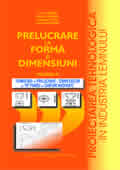
Shape and Size Processing. Tome
IV - Processing Technologies for Components
Made of Edge-Battened Panels (in Romanian
language)
Editura Universitatii "Transilvania",
Brasov, 2008
ISBN 978-973-635-936-1, 563 pg.
For orders, please contact the authors
at the following address: icismaru@unitbv.ro
|
| |
|
According to the general
objectives of the book, this fourth volume
presents the classification and systematization
of the furniture components made of edge-battened
panels. Using as main classification criterion
the processing technologies, eight major
groups were defined, depending on the edge
trajectory (linear and rectangular edges,
polygonal trajectory, continuous curved
trajectories, curved lines combined with
broken lines), each of these groups having
two variants of processing the edge: profiled
or not profiled.
The technology is different for the groups
of components presented above, both from
the viewpoint of the machine assemblies
and the devices used.
What remains for the user is to include
his own products into the appropriate group
and to benefit of the type of technology
presented in the book.
|
|
|
Marina CIONCA
Parametric Modelling of Wooden
Products with AutoCAD Mechanical Desktop.
Laboratory Works. Vol. 3
Editura Universitatii "Transilvania",
Brasov, 2007
ISBN CARTE: 973-635-538-1
ISBN VOLUM 3: 978-973-635-781-7, 160 pg.
For orders, please contact the authors
at the following address: teomih@unitbv.ro
|
| |
|
This third volume of the
book completes the previous volumes with
techniques regarding computer-aided design.
The total of 14 practical applications present
step by step generation methods of 3D parametric
models of products and parts of furniture,
doors, windows, spiral staircases, pneumatic
transport equipment elements, and furniture
fittings. Two of these applications focus
on generating technical documentation using
3D models, and one deals with a finite element
analysis.
The book has been designed not only for
the students of the Faculty of Wood Industry,
but also for specialists working in fields
which involve computer-aided design activity.
e ancient origin of the utilization of sliced
wooden branches for veneering furniture
surfaces.
|
|
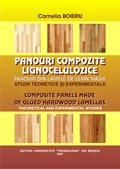
Camelia BOIERIU
Lignin-Cellulose Based Composite Panels.
Composite Panels Made of Glued Hardwood
Lamellas. Theoretical and Experimental Studies
(in Romanian language)
PUBLISHED IN:
Carl Hanser Verlag, Leipzig, 2006
ISBN-10: 3-446-40477-5; ISBN-13: 978-3-446-40477-9
204 pg.
For orders, please contact the authors
at the following address: cboieriu@unitbv.ro
|
| |
|
The present book addresses
to the specialists in wood industry field
and offers theoretical and experimental
data on a new product, possible to be used
in furniture industry and interior design:
a lignin-cellulose based composite material,
obtained by gluing small-sized lamellas
of various hardwood species (beech and others),
which confers a special appearance to the
product, characterized by the variation
of color, texture and shade.
The book presents five types of finger-jointed
panels, manufactured according to the proposed
concept. These are analyzed from the viewpoint
of physical and mechanical properties, stability
and rigidity, using both modern theoretical
methods (FEM) and the results of original
experimental tests. The reader is thus offered
a database comprising the performances of
this type of panels, to be compared with
the performances of other similar products,
used at present time.
|
|
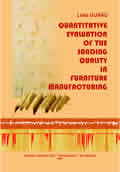
Lidia
GURAU
Quantitative Evaluation of the
Sanding Quality in Furniture Manufacturing
Editura Universitatii "Transilvania",
Brasov, 2007
ISBN: 978-973-598-126-6, 266 pg.
For orders, please contact the authors
at the following address: rgurau@rdslink.ro
|
| |
|
This book offers for the
first time in the field of woodworking a
comprehensive guide concerning the wood
surface metrology. It contains an in depth
view over the topography of processed wood
surfaces, information about how sanding
interacts with wood and about how to reliably
evaluate the influence of its variables
upon the surface quality in furniture manufacturing.
It also contains a complex review of the
methods for measuring and evaluating the
quality of sanded wood surfaces, while offering
a set of recommendations that can be suitable
for this heterogeneous material. It is addressed
both to researchers and students regarded
as future woodworking specialists.
|
|
|
|
|
|
|
|
|