|
|
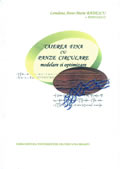
Loredana Anne-Marie Badescu
Fine Cutting by means of Circular Saw Blades – Modelling and Optimization (in Romanian language)
Editura Universitatii “Transilvania”, Brasov 2004
ISBN 973-635-386-9
212 pag. |
| |
This book addresses to specialists involved in the field of wood science and technology, especially researchers, Master students and PhD-students, with a view to optimizing the wood sawing process. After analyzing previous researches performed in this field by specialists from inside and abroad, the author presents the influence of several other parameters which interfere within the sawing process when using circular saw blades.
Two models are presented: an analogical one and a mathematical one. The obtained data are analyzed, explained and then, an optimization model is presented, based on the quality criterion, respectively the quality of processed surfaces. Although this is not a usual optimization criterion with sawing processes, the book brings strong motivations for which this criterion should be promoted and which, finally, can lead to the elimination of the straightening operation.
The paper is a challenge for researchers, considering that its contents can be identified with the reflection of Leonardo da Vinci: “FIRST STUDY THE SCIENCE AND THEN CONTINUE WITH THE PRACTICAL APPLICATION GENERATED BY THIS SCIENCE” |
|
Teofil Mihailescu
Parametric Modelling of Wooden Products with Autocad Mechanical Desktop – Vol. I (in English language)
Editura Universitatii “Transilvania”, Brasov 2005
ISBN 973-635-566-7
208 pg. |
| |
This book is dedicated to the students of the Wood Industry Faculty as well as to wood industry engineers, offering them a guide to one of the most powerful CAD tools – AutoCAD Mechanical Desktop.
The first volume of this book offers guidance needed for successful training in computer-aided design of finite wooden products. Readers will find in this volume comprehensive information about the Mechanical Desktop basics: steps in parametric modelling, commands, interface, basic concepts of creating profiles, using design variables, creating and editing features, creating assemblies, as well as animation.
Editing this book was made possible thanks to the software donation offered by AutoDesk through A&C INTERNATIONAL S.A. Bucharest, whom we address a special acknowledgement. |
|
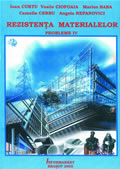
Ioan Curtu, Vasile Ciofoaia, Marius Baba, Camelia Cerbu, Angela Repanovici
Material Strength – Applications IV (in Romanian language)
Editura Infomarket, Brasov 2005
ISBN 973-8204-76-3
236 pg.
|
| |
This represents the fourth volume of a complex book containing a number of 1416 material strength applications. The book is mainly designated for students of engineering faculties, but not only, as it may be useful to all engineers who wish to refresh their applicative knowledge in this field.
The novelty consists of:
- applications presented as quiz type;
- adaptation of the treated applications to the specific of various engineering specialities; a large share is reserved to the study cases regarding the strength, rigidity and stability of wooden parts and wooden structures, as well as of other wood-based materials;
- integral presentation of the solution for the most difficult applications.
The book also contains a series of annexes useful to the engineers for material strength calculations. |
|
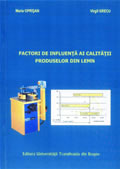
Maria Oprisan, Virgil Grecu
Influencing Factors for the Quality of Wooden Products (in Romanian language)
Editura Universitatii “Transilvania”, Brasov 2004
ISBN 973-635-259-5
170 pg |
| |
The book presents the main factors which influence the quality of wooden products under production conditions. The experimental data obtained were statistically processed. Calculation formula, examples and results are presented. In order to emphasize the influence of several factors upon quality, it was necessary to present in detail the processing accuracy of the machines employed, the adjusting methods used and the measuring and control equipment used within the furniture manufacturing sector.
According to the complex topic approached, resulting from the correlation between the numerous factors taken into consideration, as well as from the obtained results, this work may constitute a great help for specialists in this area, contributing also to the optimization of the manufacturing process and the improvement of wooden products quality. |
|
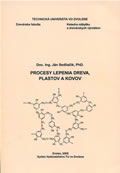
Jan Sedliacik
Procesy lepenia dreva, plastov a kovov / Gluing Processes for Wood, Plastics and Metals (in Slovak language)
Editura Universitatii Tehnice din Zvolen, 2005
ISBN 80-228-1500-4
220 pg. |
| |
After an interesting and well-documented introductory chapter regarding the evolution of gluing materials along the history, the influencing factors depending on the support type (wood, plastic, metal) are analyzed, as well as the modality of preparing the support for gluing. Chapter 5, which encompasses the largest share of this work, refers to the adhesives in use, their preparation, as well as the gluing defects and the prognosis of the resulting joints resistance.
All these aspects are competently presented, scientifically sustained by numerous parameters of the gluing conditions, which confer this work an enhanced practicality.
The annexes referring to terminology, classifications and even a four-language dictionary of the technical terms used in this area are to be remarked. |
|
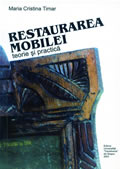
Maria Cristina Timar
Furniture Restoration - Theory and Practice (in Romanian language)
Editura Universitatii “Transilvania”, Brasov 2003
ISBN 973-635-144–0
137 pg.
|
| |
At the same time science and art, restoration is a complex activity meant to assure the conservation of the cultural heritage. Restoration aims at bringing back as close as possible to the original form and state any cultural item, without altering its original patina and the historical information. Restoration is always associated with conservation measures in order to prolong the life of the restored objects.
The book is structured in 12 chapters and it refers to the main theoretical and practical aspects of furniture restoration: general principles, code of ethics, types of defects and degradation factors, investigation methods, necessary materials, restoration-conservation techniques for solid wood, veneered surfaces, restoration of finishes, gilded wood and painted wood.
The book is addressed to all of those who have the desire to know and even practice, as a permanent job or as a hobby, a complex and time consuming but also extremely rewarding activity. |
|
|
|